The most effective Zi0n feature against rogue cable attacks
Plugging in a USB cable feels like the most harmless step in our daily mobile routine. Yet in the hands of an adversary or within an untrusted environment, an ordinary charging cord can act as a potent attack vector capable of compromising a smartphone within seconds.
To counteract the rise of covert surveillance cables and tampered charging points, Zi0n deploys an uncompromising countermeasure: Wipi technology coupled with hardware-level USB controller isolation.
The anatomy of a rogue cable and its covert danger
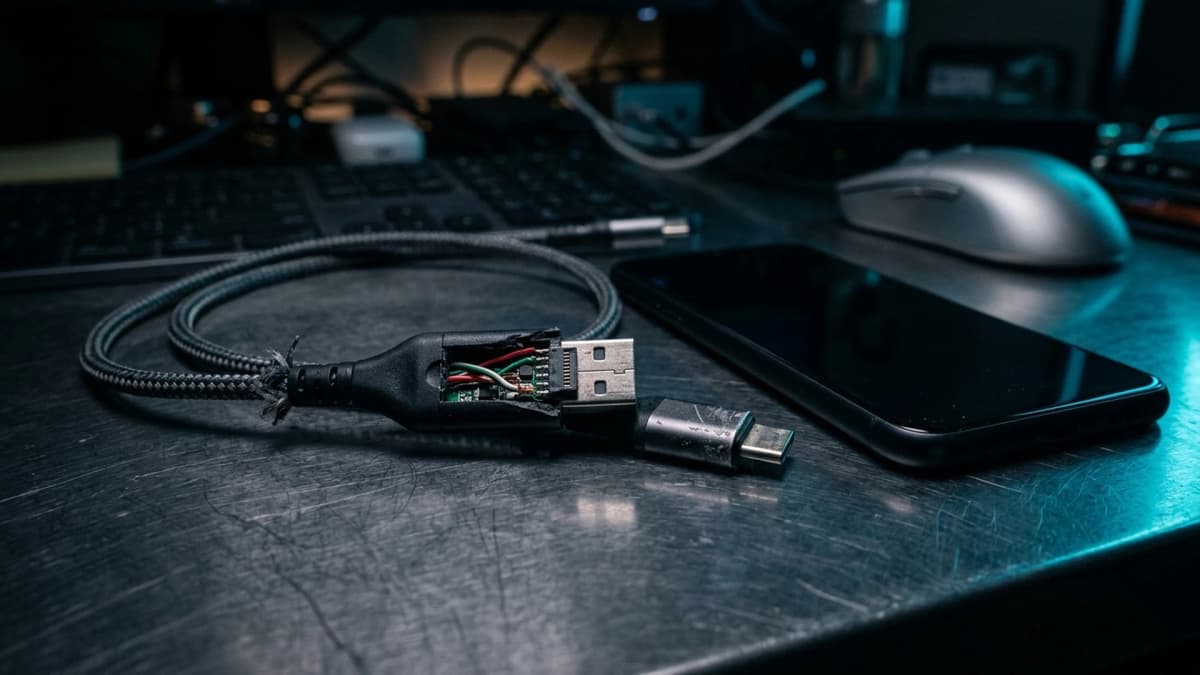
At first glance, a rogue cable is indistinguishable from the factory cord supplied with standard commercial smartphones. Its outer jacket and molded connectors show no visible abnormalities. Beneath that familiar casing, however, adversaries conceal a miniature microcontroller, a wireless transceiver, or an automated keystroke injector such as an O.MG cable or BadUSB implant.
When plugged into an ordinary smartphone, the covert chip masquerades as a high-speed human interface device (HID keyboard). Within a fraction of a second, the malicious accessory injects automated keystrokes that bypass initial permissions, install background spyware, or initiate the exfiltration of private keys and crypto wallet credentials.
On commercial mobile devices, data lines remain receptive by default while charging, leaving a direct conduit straight into memory.
Zi0n's decisive defense: Wipi protection and hardware port lockdown
Rather than relying on passive software alerts after a breach begins, Zi0n enforces strict physical policies governed by its dedicated security silicon and hardened operating system.
Electrical isolation of data lines while locked
Whenever the Zi0n screen is locked, the USB hardware controller disconnects the differential data lines (D+ and D-). Even if a malicious cord attempts to inject keystrokes or negotiate an unauthorized connection, the processor refuses data communication at the circuit level. The phone permits only basic electrical power across the VBUS and ground lines to recharge the battery.
Rapid cryptographic purge through Wipi
In scenarios where an attacker employs specialized forensic extraction hardware to bypass port restrictions, Wipi takes instant charge. The architecture detects illicit data negotiation attempts within microseconds.
True physical defense allows no hesitation: destroying cryptographic master keys ahead of an intrusion permanently prevents unauthorized access.
Wipi immediately instructs the Secure Element to shred the AES-256 master encryption keys held in hardware isolation. Deprived of those essential keys, the device storage becomes an unreadable matrix of scrambled bytes, rendering private conversations, crypto recovery phrases, and sensitive records completely irrecoverable.
Practical habits for physical port safety
Adopting clean physical habits drastically reduces exposure while traveling through airports, hotels, and shared workspaces:
- Hardware data blockers: insert a physical USB data blocker that severs data lines when using public charging kiosks.
- Vigilance with borrowed cables: avoid using charging cords provided by unknown third parties or left unattended in meeting rooms.
- Immediate lock timers: ensure your device locks instantly the moment you step away or finish an interaction.
How Zi0n keeps your operations secure
Wipi operates as an integral element within Zi0n's comprehensive security architecture. Combining airtight user profile sandboxing, an OS hardened from GrapheneOS foundations, an emergency duress PIN, and a decentralized VPN with continuous IP rotation, Zi0n neutralizes both remote network exploits and close-contact hardware tampering. Discover the full platform at https://zi0n.io.
Frequently asked questions
Can an authentic wall charger accidentally trigger Wipi?
No, genuine chargers only supply electrical power on designated pins and never request data negotiations, eliminating false alarms.
What is a BadUSB attack on mobile devices?
It occurs when a peripheral mimics a keyboard to execute malicious commands at lightning speed without explicit user confirmation.
Can erased data be retrieved after Wipi triggers?
No, the cryptographic key destruction inside the Secure Element is permanent and irreversible, making offline backups essential.
Does Wipi require an active cellular or Wi-Fi connection?
No, the mechanism operates entirely on local hardware and functions seamlessly in airplane mode or within Faraday shielding.