Suspicious cable detection: how Wipi prevents physical hacking
Plugging a smartphone into an unknown USB socket or facing physical confiscation exposes the device's cryptographic foundation to severe risk. Physical attacks via cable are no longer confined to intelligence agencies: from microcontroller-laden malicious cables to automated forensic workstations, physical extraction can occur before the screen lock is ever touched. To counter this critical attack surface, Zi0n implements Wipi, an active hardware-level defense mechanism.
Physical intrusion vectors through malicious cables
Far beyond innocent wall-charging leads, several hostile technologies exploit direct physical connection to mobile communication buses:
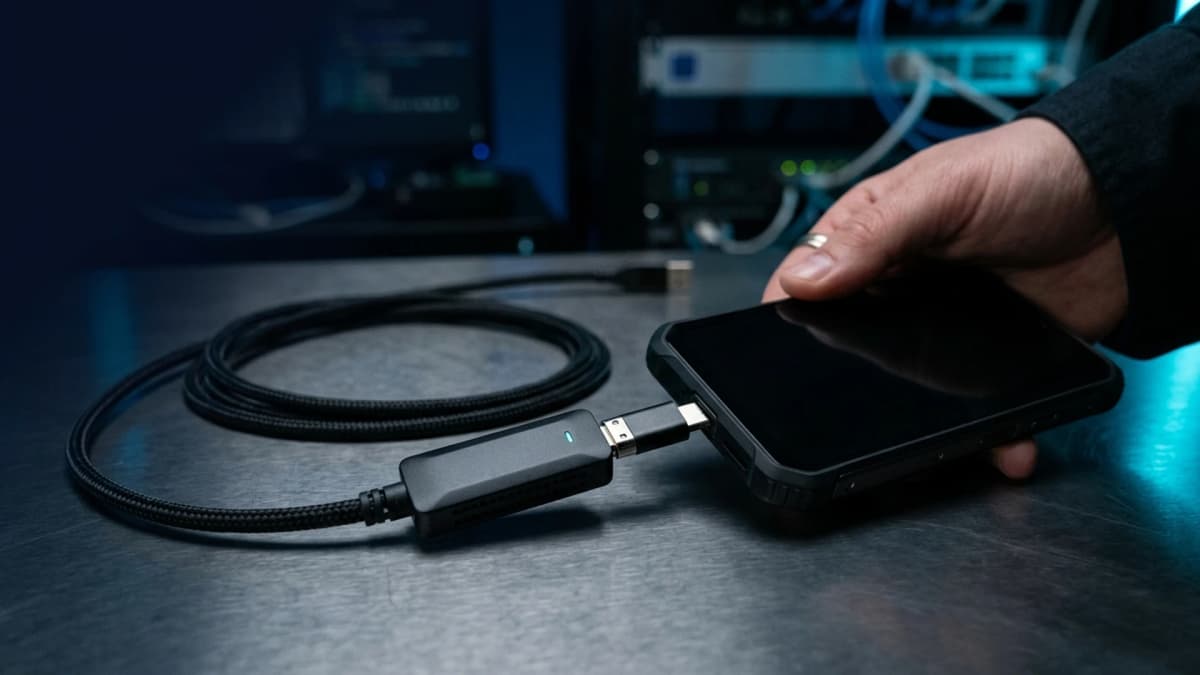
- Implanted smart cables (such as O.MG or BadUSB): innocent-looking charging cables concealing high-speed microcontrollers, wireless radios, or HID injection payloads capable of deploying malicious commands within milliseconds of connection.
- Forensic extraction hardware (Cellebrite UFED, GrayKey): specialized law enforcement and forensic appliances that trigger low-level recovery states (BootROM or EDL mode) to exploit USB controller flaws and bypass software authentication.
- Compromised public charging points (juice jacking): charging ports in airports, railway hubs, and conference halls modified to silently siphon device authentication tokens while supplying electrical current.
- Hardware bus sniffers and signal analyzers: inline diagnostic tools designed to intercept packets traversing the cable and extract unencrypted cryptographic material remaining in volatile memory.
When physical communication channels remain responsive to unsolicited handshakes, critical private keys and sensitive records are placed in jeopardy almost immediately.
How Wipi detects and mitigates physical threats in real time
The Wipi feature on Zi0n does not rely on high-level userland daemons that could be frozen or hijacked by an exploit payload. Instead, it leverages low-level monitoring within the physical controller architecture.
1. Hardware monitoring of USB communication lines
As soon as a cable connector enters the port, Wipi evaluates incoming electrical behavior. Standard power adapters supply voltage exclusively across power rails (VBUS and ground). Any detected handshake or signal activity on the differential data pins (D+ and D-) or USB-C configuration channels triggers an instant security alert whenever the device is in a secured lock state.
2. Nanosecond cryptographic zeroization
Upon identifying a suspicious cable profile or an unauthorized data negotiation attempt, Wipi triggers an automated cryptographic zeroization sequence. The AES-256 master storage keys residing in the hardware Secure Element are obliterated within nanoseconds. Without these hardware-isolated keys, flash memory storage is reduced to mathematically indecipherable pseudo-random noise, invalidating all physical dumping efforts.
3. Full offline autonomy within Faraday shielding
Conventional enterprise remote wipe tools (MDM) fail completely once a seized phone is placed inside an RF-shielded Faraday pouch or stripped of its SIM card. Wipi functions entirely on device, requiring zero cellular connectivity, Wi-Fi access, or external server commands to execute its protocol.
Practical guidelines to defend against hardware tampering
To safeguard personal assets and mission-critical communications against physical intrusion attempts, apply these defensive guidelines:
- Never use untrusted cables: avoid using borrowed cables, unlabeled cords found in meeting spaces, or free charging accessories.
- Carry a dedicated USB data blocker: if connecting to an unfamiliar power socket is unavoidable, insert a physical data blocker that severs the data pins entirely.
- Enable Wipi heightened protection during transit: ensure your Zi0n device has suspicious cable detection active before moving through airport security, border checkpoints, or hostile venues.
- Maintain offline cryptographic backups: store recovery seeds and essential vault passwords on air-gapped physical media rather than keeping only a single mobile copy.
How Zi0n can help you
Zi0n equips security-conscious individuals with an operating system engineered to withstand physical access threats. Through its built-in Wipi engine, any rogue cable detection or hostile extraction attempt prompts immediate data lockdown and cryptographic sanitization. Combined with tamper-resistant hardware and comprehensive communication isolation, Zi0n ensures that your private files, cryptographic wallets, and confidential records stay shielded against sophisticated physical exploitation. Discover the complete security framework at https://zi0n.io.
Frequently asked questions
Will Wipi trigger when using my original wall charger? No. The firmware continuously differentiates between clean power delivery and active host data lines, only intervening when hostile data negotiation is detected during protected states.
Can specialized recovery services retrieve data after Wipi zeroization? No. Once the master AES-256 keys inside the Secure Element are wiped, reconstructing the filesystem is mathematically impossible, even through advanced chip-off analysis.
Does Wipi require an active internet connection to safeguard the device? No. The entire verification and protection logic executes strictly on the local hardware microcontroller, ensuring full protection inside Faraday enclosures or offline locations.
How does Wipi differ from standard Android charge-only settings? Android charge-only modes are high-level software settings vulnerable to bootloader and kernel exploits; Wipi acts as an automated, hardware-enforced cryptographic circuit breaker.